A roof leak rarely announces itself politely. Usually it starts as a faint discoloration on a bedroom ceiling, a drip you hear at 3 a.m., or a musty smell in an upstairs closet that you cannot quite place. You are likely asking two questions: what caused it, and what will the roof leak repair cost? Most homeowners pay between $350 and $1,550 to fix a roof leak, with a national average around $800. Simple fixes such as a worn vent boot can run under $400, while a leak that has reached the roof decking or framing can climb past $3,000. This guide breaks down the causes, the warning signs, the cost by cause, and how to stop the damage before it spreads.
Common Causes of Roof Leaks
Roof leaks almost never start where the water appears. Water enters at one point on the roof, travels along the sheathing or a rafter, and drips onto your ceiling feet away from the actual hole. That is why finding the true source matters more than patching the stain.
Damaged or Missing Shingles
Asphalt shingles fail when wind lifts the tabs and breaks the seal strip, when hail cracks them, or when age makes them brittle and they curl or blow off entirely. A single missing shingle exposes the underlayment beneath, and once that barrier is compromised, water has a direct path to the roof deck. This is one of the cheapest leaks to fix — the shingle itself costs a few dollars — but only if it is caught before the decking soaks through.
Cracked Flashing
Flashing is the thin metal that seals the joints where the roof meets a wall, chimney, skylight, or valley. It is arguably the single most common source of roof leaks, accounting for a large share of residential leak claims. Flashing fails when galvanized metal rusts through, when sealant dries out and cracks, or when a previous installer simply caulked over it instead of replacing it. Because flashing sits at the roof’s trickiest transitions, these leaks can be difficult to diagnose and to repair properly.
Clogged Gutters
Gutters filled with leaves and debris stop channeling water away from the roof. Instead, water backs up under the shingle edges at the eaves, soaks into the fascia board, and eventually finds its way into the walls or the soffit. In colder climates, a clogged gutter also feeds ice dams. A clogged gutter is a maintenance problem that turns into a roofing problem faster than most homeowners expect.
Chimney and Skylight Issues
Chimneys and skylights both interrupt the roof’s water-shedding surface, and both depend on a multi-piece flashing system to stay dry. Around a chimney, the step flashing and counter-flashing work together; when the counter-flashing pulls loose from the mortar joint or the crown cracks, water runs down the brick and into the attic. Skylights rarely leak through the glass itself — the failure is almost always the curb flashing around the unit or a failed seal.
Roof Valleys
Valleys are the V-shaped channels where two roof slopes meet. They funnel more water than any other part of the roof, so they fail under heavy flow. Valley leaks typically come from worn or rusted valley metal, granule loss in the shingles that line the channel, or nail holes punched too close to the centerline. Because valleys concentrate water volume, a leak here tends to move fast and do real damage before you notice it.
Ice Dams
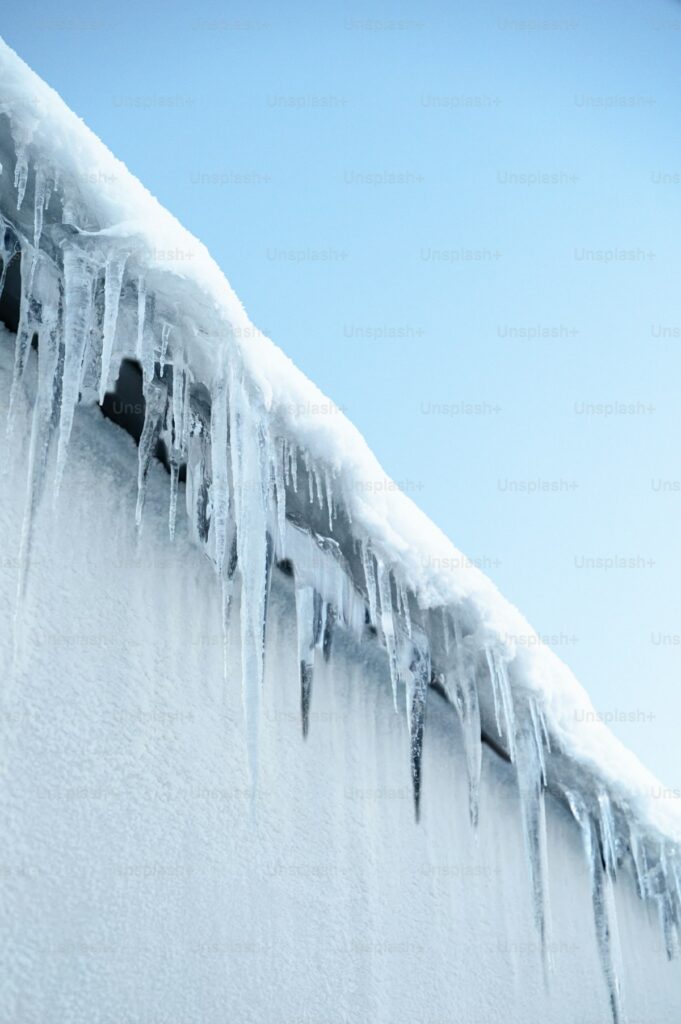
In colder regions, warm air leaking from the attic melts snow on the upper roof; the meltwater runs down and refreezes at the cold eave, forming a ridge of ice. Water then backs up behind that ridge and pushes under the shingles. Ice dams are less a single failure point than a symptom of poor attic insulation and ventilation, and the durable fix addresses the attic, not just the ice.
Worn Pipe Boots
Every plumbing vent stack pokes through the roof inside a rubber or metal collar called a pipe boot. The neoprene gasket on that boot degrades under years of UV exposure and temperature swings until it cracks, letting water track down the pipe. It is one of the most common leak sources on homes eight years and older, and one of the cheapest to fix.
Signs You Have a Roof Leak
Roof leaks do not always present as an obvious puddle. Catching one early is the difference between a few hundred dollars and a structural repair. Watch for these signals.
- Stains on ceilings or walls. Brown, yellow, or copper-colored rings on a ceiling are the classic sign. A stain that grows after rain, or that has a darker outer ring, means the leak is active.
- Drips or water in the attic. After a storm, check the attic with a flashlight. Look for wet insulation, water streaks on rafters, or daylight showing through the decking.
- A musty or damp smell. Trapped moisture in insulation, drywall, or carpet produces a persistent musty odor even when no visible water is present.
- Peeling paint or bubbling drywall. Water absorbed behind a painted surface makes paint blister, bubble, or flake, and can leave drywall soft or sagging.
- Mold or mildew. Dark spots on ceilings, walls, or attic framing often indicate long-standing moisture — a sign the leak has been running longer than you realize.
- Damaged shingles or flashing outside. Missing shingles, rusted flashing, or loose boots you can spot from the ground are a leak waiting to happen.
Roof Leak Repair Cost by Cause
The cause of the leak drives the price more than any other factor. The figures below reflect 2026 national ranges reported by Fixr, HomeAdvisor, and Angi; your actual cost will vary by region, roof pitch, accessibility, and how far the water has already traveled. Labor typically makes up 60% or more of the bill, and most roofers apply a trip-charge floor of roughly $250 to $450 even for a small job.
| Leak cause | Typical repair cost |
|---|---|
| Clogged gutters (cleaning/clearing) | $100 – $250 |
| Worn pipe boot / vent boot | $100 – $600 |
| Damaged or missing shingles | $150 – $700 |
| Nail pops | $200 – $500 |
| Cracked or failed flashing | $200 – $600 |
| Skylight leak (re-flash/reseal) | $300 – $800 |
| Valley leak | $300 – $1,500 |
| Ice dam damage | $400 – $1,500 |
| Chimney leak (flashing or crown) | $200 – $3,500 |
These are repair-only ranges for the roof itself. If the leak has already soaked through the sheathing, expect to add decking replacement at roughly $400 to $1,000 per 4-by-8 sheet of plywood or OSB. Interior repairs are a separate line item entirely: patching and repainting a stained ceiling typically runs $200 to $600, replacing soaked insulation $300 to $1,200, and mold remediation anywhere from $500 to over $3,000 depending on the area. The longer a leak runs, the more of these secondary costs stack on top of the roof work.
DIY vs. Professional Roof Leak Repair
It is tempting to grab a ladder and a tube of sealant, and for a couple of narrow cases a homeowner can handle the fix. But most roof leak repairs belong in a professional’s hands — not only for quality, but for safety.
What a confident DIYer can reasonably tackle: clearing clogged gutters, replacing a single damaged shingle on a low-slope, one-story roof, and swapping a cracked pipe boot when the boot is accessible and the surrounding shingles are in good shape. Material costs for these jobs are modest — a boot runs $20 to $40, a bundle of shingles under $40 — but the real cost of DIY is risk and misdiagnosis.
What should always go to a licensed roofer: any work on a roof steeper than a 6/12 or 7/12 pitch, anything on a two-story home, flashing repairs that require lifting siding or cutting mortar joints, valley reconstruction, skylight flashing, and any job where the decking may be rotted. These are the repairs where a mistake doesn’t just leak again — it creates a bigger problem, and the fall risk on a steep or high roof is not worth the savings. Roofers also carry liability and workers’ compensation insurance, and a professional repair typically comes with a workmanship warranty.
One caution: be wary of the “patch.” Slathering roofing cement over flashing may stop a drip for a season, but it is a $250 to $400 temporary fix that fails again, often within a year, and makes the eventual proper repair more expensive because the cement has to be removed first. A real repair — replacing the failed component — is the only fix that lasts.
Emergency Tarping: Stopping the Damage Now
When a leak is active and you cannot get a roofer out the same day, a tarp is the right first move. A properly secured tarp stops water from entering while you schedule the permanent repair, and it limits the interior damage that drives the total bill up. A temporary roof tarp typically costs $200 to $1,000 depending on roof size, pitch, and how quickly you need it, and most insurance policies will reimburse reasonable emergency mitigation as part of a covered claim. The key is securing the tarp correctly: anchor it over the ridge so water runs over it, not under it, and fasten it with wood strips or sandbags — never nails driven through the roofing, which create the next leak. Document the damage with photos before and after tarping for your insurer. See our emergency roof tarping guide for a step-by-step process.
Preventing Roof Leaks
The cheapest roof leak is the one that never happens. A few habits keep most leaks from forming in the first place.
- Inspect the roof twice a year — once in spring, once in fall — and after any major storm. Look for missing shingles, cracked sealant, rusted flashing, and lifted tabs. See our roof inspection guide for what to check.
- Keep gutters clean. Clear them at least twice a year, more often if trees overhang the roof. Clogged gutters are a leading contributor to eave and ice-dam leaks.
- Replace worn boots and sealant early. Pipe boots and sealant have a finite lifespan. Replacing a $30 boot on your schedule beats a $600 repair on the leak’s schedule.
- Maintain attic insulation and ventilation. This is the durable fix for ice dams and it also slows shingle aging by keeping attic temperatures stable.
- Trim overhanging branches. Limbs that scrape shingles in the wind strip granules and create weak spots, and a falling limb is a puncture waiting to happen.
- Address small problems immediately. A single missing shingle is a quick fix; ignored for a season, it becomes a rotted deck and a much larger bill.
If your roof is past 15 to 20 years old and you are patching leaks repeatedly, or if repairs are starting to total 30% or more of a full replacement, the better financial move may be a new roof rather than the next repair. See our signs you need a new roof guide to evaluate where your roof stands.
FAQ
How much does it cost to fix a roof leak?
Most roof leak repairs cost between $350 and $1,550, with a national average around $800, according to Fixr and HomeAdvisor. Angi’s 2026 data puts the broader range at $700 to $3,000, with many homeowners paying about $900. Simple repairs like a vent boot run under $400; leaks involving decking or structural damage can exceed $3,000.
Does homeowners insurance cover roof leak repair?
It depends on the cause. Insurance generally covers sudden, accidental damage — a tree limb through the roof, or a wind or hail event — minus your deductible. It typically does not cover leaks from gradual wear, neglect, or a lack of maintenance, such as a pipe boot that simply aged out. If the damage is covered, emergency tarping and interior mitigation are usually reimbursable as part of the claim.
How fast should I fix a roof leak?
Immediately. A small leak that runs for a few weeks can soak insulation, rot the decking, and grow mold, turning a $400 repair into a $4,000 one. If you cannot schedule a roofer the same day, tarp the area and contain the interior water in the meantime.
Can I repair a roof leak myself?
For small, low-risk jobs — clearing gutters, replacing a single shingle on a low one-story roof, or swapping an accessible pipe boot — a careful homeowner can manage. Anything involving flashing, valleys, skylights, steep or high roofs, or suspected deck rot should go to a licensed roofer for both quality and safety reasons.
What is the most expensive roof leak to fix?
Chimney leaks and valley leaks on steep or specialty roofs tend to run the highest, because they require rebuilding a multi-part flashing system or reconstructing the valley, and they often involve masonry work or rotted decking. A complex chimney re-flash with a new cricket can reach $2,000 to $3,500 or more.
The Bottom Line
A roof leak is a race between a small repair and a large one. Most leaks cost between $350 and $1,550 to fix when they are caught early, and the cause — a cracked boot, a failed piece of flashing, a clogged gutter — usually points to a straightforward solution. The expensive part is almost never the initial leak; it is the water damage that accumulates while the leak goes untreated. If you spot a stain, hear a drip, or smell dampness upstairs, act now: find the source, tarp it if you must, and get a professional repair scheduled before a minor fix becomes a structural one. See our roof repair cost guide for a full breakdown of what to expect when you call a roofer.